Most Atlanta homeowners go years
without thinking about their sewer line. It runs underground from the house to
the city's main or septic system, and as long as the drains work, there is no
reason to give it a second thought.
Until there is. A damaged or blocked sewer line causes problems that are impossible to ignore: sewage backing up into the house, foul odors from the yard, soggy patches in the lawn, or slow drains throughout the home. When these symptoms appear, the diagnosis and repair process needs to move quickly.
Why Atlanta Sewer Lines Fail
Sewer line failures follow predictable patterns. The cause determines the severity and urgency of the repair.
Tree Root Intrusion
Tree roots are drawn to the
warmth and moisture inside sewer pipes. They enter through hairline cracks,
deteriorating joints, or small gaps in older pipe materials and grow to fill
the interior over time. A root mass that starts as a minor obstruction will
eventually block flow entirely.
This is the leading cause of sewer line problems in Atlanta's established neighborhoods. The city's combination of clay soil, high annual rainfall, and one of the densest mature urban tree canopies in the country, primarily oaks, sweetgums, and maples with extensive root systems, creates ideal conditions for root intrusion. Neighborhoods like East Cobb, Tucker, Decatur, Smyrna, and Dunwoody see this regularly in homes built from the 1950s through the 1980s.
Aging and Deteriorating Pipe
Atlanta's post-WWII housing boom
produced a large inventory of homes built between 1945 and 1975. The sewer
lines installed during this period were made from materials that have long
exceeded their design life:
- Orangeburg pipe: a compressed fiber material widely used through the early 1970s that absorbs moisture, deforms, and eventually collapses under soil pressure. Atlanta has a significant concentration of Orangeburg in its older residential sewer lines
- Clay tile: fired clay sections joined with mortar that cracks under root pressure and ground movement
- Cast iron: durable when new, but corrodes from the inside over decades, eventually developing pinhole leaks and joint failures
A pipe installed 50 or 60 years ago, never inspected or serviced, may be in significantly worse condition than its drainage performance suggests. Partial failures develop slowly, and homeowners often live with increasingly slow drains for years before a full blockage or backup finally prompts investigation.
Soil Movement and Joint Separation
Atlanta's expansive clay soil contracts in dry conditions and expands when wet, cycling through this movement every season. Over decades, this constant pressure shifts buried pipes, separates joints, and creates low spots called bellies where waste collects rather than flowing through. A pipe with multiple separated joints or a significant belly will cause recurring problems even after repeated clearing, because the structural issue has not been addressed.
Grease and Debris Buildup
Cooking grease, soap scum, and food particles accumulate on pipe walls over time. On a structurally sound pipe, buildup alone rarely causes a complete failure. But in combination with partial root intrusion, a pipe belly, or already-narrowed cast iron, buildup accelerates blockages significantly.
Signs You May Have a Sewer Line Problem
Sewer line problems rarely
appear without warning. These symptoms, particularly in combination, indicate
the main line needs professional evaluation:
- Multiple slow drains throughout the house at the same time, not just one fixture
- Gurgling sounds from the toilet or other drains when water runs elsewhere in the home
- Sewage backs up into the tub or shower when the toilet is flushed
- Foul sewage odors coming from drains, the yard, or the area around the foundation
- Soggy, unusually green, or sunken patches in the yard above the sewer line path
- A water bill that has increased without explanation, which can indicate a break in the line
The more of these symptoms that are present simultaneously, the more likely the problem is in the main sewer line rather than a branch line serving a single fixture. Our Atlanta sewer line specialists recommend calling for a camera inspection rather than waiting when multiple symptoms appear together.
How Professional Sewer Line Repair Works
The repair process follows a consistent sequence regardless of the specific problem.
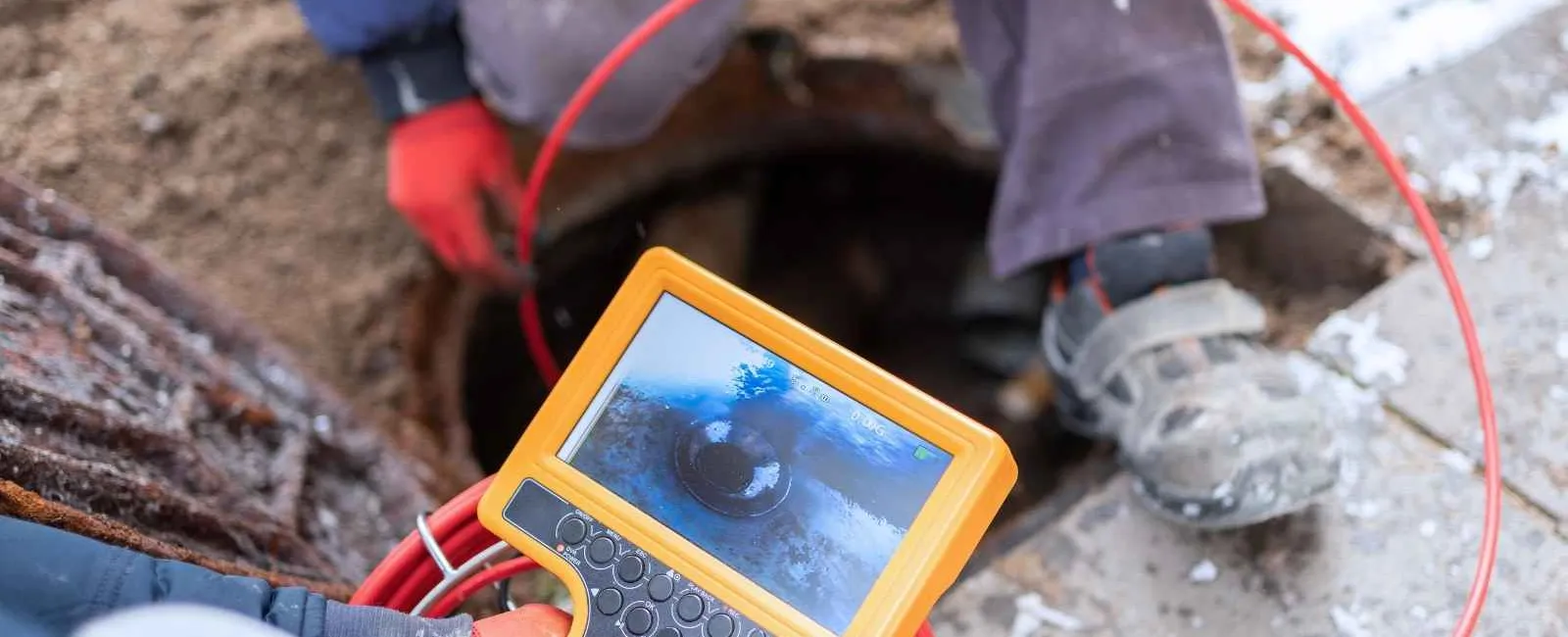
Step 1: Camera Inspection
Every sewer line evaluation
begins with a camera inspection. A waterproof camera on a flexible cable is fed
through the line from a cleanout access point, transmitting live footage of the
pipe interior. The inspection reveals:
- The exact location and extent of root intrusion
- Sections of pipe that have cracked, collapsed, or separated at joints
- Buildup accumulation and where it is most concentrated
- Pipe material, which determines the repair approach
- Whether the problem is repairable or requires replacement of the affected section
Camera inspection eliminates guesswork. A plumber who recommends sewer line repair without first running a camera is working blind, and that leads to repairs that either address the wrong section or fail to resolve the underlying cause. At Dalmatian, the homeowner reviews the camera footage before any repair decision is made.
Step 2: Drain Cleaning If Needed
If the camera reveals a blockage that has not yet caused pipe damage, the first step is clearing it. Professional drain cleaning with a power auger or hydro jetter removes root masses, grease buildup, and debris from the line. In some cases, this is the complete solution. In others, cleaning the line reveals structural damage underneath the obstruction that requires repair.
Step 3: Repair or Replacement of the Damaged Section
When structural damage is
confirmed, the repair involves excavating to access the affected section and
replacing it. The scope depends on what the camera found:
- A short section with a crack, joint separation, or root damage is typically a targeted repair involving excavating that section, removing the damaged pipe, and replacing it with new pipe connected to the sound sections on either side
- A longer run of deteriorated Orangeburg, collapsed clay tile, or heavily corroded cast iron may require replacing the entire affected length, which involves more excavation but produces a permanent solution with new pipe material
- A pipe belly, where ground movement has created a low spot, requires excavating the belly section and relaying the pipe at the correct grade so waste flows freely
The excavation is targeted at the damaged section rather than the full pipe run. After the repair is complete, the line is tested, and a follow-up camera run confirms the fix before the trench is backfilled and the surface is restored.
Repair vs. Replacement: How the Decision Is Made
Not every sewer line problem requires replacing the entire line, and not every damaged section can be spot-repaired. The camera footage determines which approach makes sense.
Targeted repair is appropriate when: The damage is isolated to a short section of otherwise sound pipe. The pipe material is in good condition, except for the specific failure point. Root intrusion is limited, and the pipe walls are still structurally intact.
Full or partial replacement is necessary when: The pipe material has failed along its entire length, as is typically the case with Orangeburg. Multiple damaged sections exist along the run, making repeated spot repairs less economical than replacing the affected length once. The pipe has collapsed to the point where it cannot be cleared or structurally restored.
Dalmatian's licensed Atlanta sewer technicians give homeowners an honest assessment of which option addresses the actual problem and why, before any work begins.
What the Repair Disrupts and for How Long
Sewer line repair requires
excavating to access the pipe, which disrupts the surface
above. What that disruption looks like depends on where the line runs:
- A line that runs through an open lawn requires digging a trench, removing sod, completing the repair, backfilling, and restoring the surface. Lawn restoration is typically straightforward
- A line beneath a concrete driveway, patio, or walkway requires cutting the concrete, completing the repair, and patching the surface. The patch may be visible depending on the age and color of the original concrete
- A line near established trees requires care during excavation to avoid damaging major root systems beyond the sewer line itself
Most targeted sewer line repairs are completed in a single day. Larger replacement projects may extend to two days. The home can typically use water and plumbing normally once the repair is complete and the line has been tested.
Why Sewer Line Problems Do Not Fix Themselves
A slow drain that has been slow
for years is easy to ignore. A single backup that clears on its own feels like
a resolved problem. But sewer line issues that are not investigated and
addressed continue to worsen:
- A small crack with minor root intrusion becomes a larger fracture with a root mass over one or two growing seasons
- A pipe belly that causes occasional slow drainage becomes a persistent collection point for waste and debris
- Orangeburg pipe that is deforming under soil pressure will eventually collapse completely, producing a full backup rather than a slow drain
The difference between investigating a slow drain when it first appears and calling for emergency service after a full sewage backup is typically several thousand dollars in damage, plus the cost of the repair itself. Early diagnosis produces a much better outcome.
Atlanta Sewer Line Repair From Dalmatian Plumbing
Dalmatian Plumbing's licensed
technicians serve Atlanta, Marietta, Kennesaw, Smyrna, Alpharetta,
Lawrenceville, and the entire metro area. We bring camera inspection equipment
to every sewer evaluation, give homeowners a clear explanation of what the footage
shows, and recommend only the repair work that the inspection confirms is
needed.
With 75-plus years of combined technician experience, same-day service availability, and 4.9 stars across 600-plus Google reviews, we are the team Atlanta homeowners trust when a sewer problem needs to be diagnosed and fixed correctly.
If you are seeing slow drains throughout the house, sewage odors, or backups into fixtures, visit our Atlanta sewer line repair and replacement page or call us to schedule a camera inspection today.