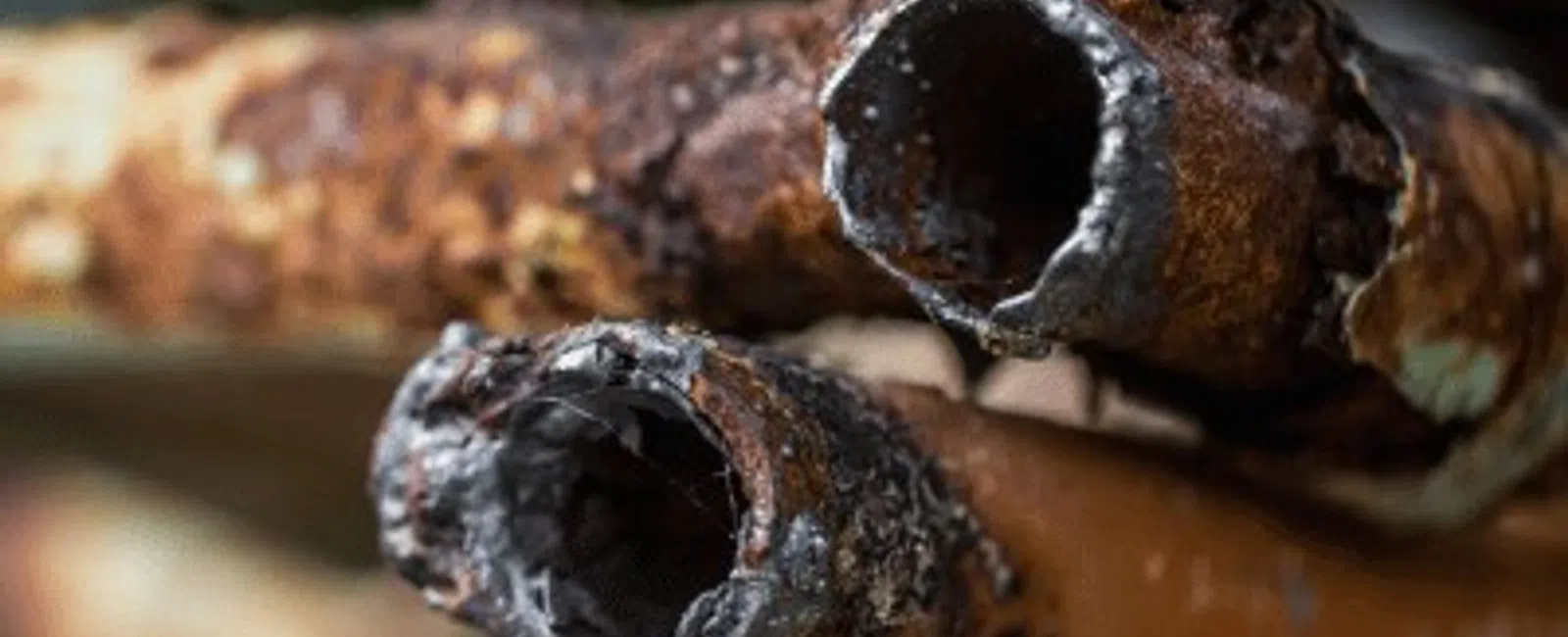
In 2017, crews in London's Whitechapel neighborhood found a fatberg longer than two football fields wedged inside a Victorian-era sewer. Sewer crews had to break it apart piece by piece with high-pressure hoses and shovels. Stories like that make fatbergs sound like a big-city problem that only public works departments deal with.
The mass under the street is the city's job. The buildup that causes trouble for homeowners starts much closer to home, inside the kitchen drain and the sewer line buried in your yard. That part is yours, and it behaves exactly like a fatberg in the making.
What a Fatberg Is
A fatberg is a hardened mass of fats, oils, and grease (often shortened to FOG) bound together with wipes, paper products, food scraps, and other debris that should never have gone down a drain. Grease leaves the sink as a warm liquid, but it cools quickly once it hits the pipe. As it cools, it sticks to the pipe wall and grabs anything that floats past.
Over time, the grease also reacts with calcium and other minerals in wastewater. That reaction turns soft grease into a waxy, soap-like material that is far harder than the fat it started as. This is why a fatberg in a sewer is so difficult to remove: it is less like a clog and more like a deposit that has bonded to the pipe.
Whose Problem Is It?
Sewer systems have two sides. The public main under the street belongs to the city or county utility, and a fatberg there is theirs to clear. Everything between your fixtures and that main is private plumbing. In most metro Atlanta communities, that includes the sewer lateral, the buried line that carries waste out of your house and connects it to the public main.
Grease rarely makes it to the city main in one piece. It cools and settles within the first stretch of pipe it travels through, which means the kitchen branch line, the drain under the slab or crawl space, and the lateral in your yard. When a grease blockage backs up into your home, the city will not send a crew to clear your side of the line. A licensed plumber handles that job.
How Grease Builds Up in a Home's Pipes
Grease buildup in pipes happens in layers. Each time a pan is rinsed or a greasy plate goes into the dishwasher, a thin coat of fat sticks to the inside of the drain. Coffee grounds, rice, and food particles from the garbage disposal catch in that coating. The next layer of grease seals them in, and the opening inside the pipe gets a little smaller.
Some homes collect grease faster than others. Older cast iron drains, common in metro Atlanta houses built before the mid-1970s, develop a rough, scaled interior that gives grease more surface to grip. Sewer lines that have sagged in the region's clay soil form low spots where grease and solids settle instead of flowing on. Homes with a heavily used garbage disposal send more food solids into the line for grease to bind with.
Wipes make the problem worse. Even the ones labeled flushable hold together long enough to snag on grease, and our look at so-called flushable wipes explains why they cause so many service calls.
Signs Grease Is Building Up in Your Lines
A grease blockage gives warning signs well before it stops the line completely:
- The kitchen sink drains slowly, clears after a plunge or a cleaning, then slows down again within weeks.
- The kitchen drain gurgles when the dishwasher or washing machine empties.
- Dirty water backs up into the sink when the dishwasher runs.
- A sour or rancid odor comes from the kitchen drain, even after the disposal is cleaned.
- Water backs up at the lowest drain in the house, such as a basement floor drain or a first-floor shower, when several fixtures are in use.
- Clogs return to the same drain again and again.
Any one of these on its own may point to a simple clog. Two or more together, especially a clog that keeps coming back, suggest grease has coated a longer stretch of pipe.
Why Store Products and Snaking Fall Short
Chemical drain openers can soften the top layer of a grease clog, but the loosened grease usually travels a few feet farther down the line, cools, and hardens again in a spot that is harder to reach. Repeated use can also damage older pipes.
A standard drain cable has a similar limitation. It punches a hole through the blockage and restores some flow, but the grease coating the pipe walls stays put. That leftover layer is why a snaked grease clog often comes back.
How Dalmatian Plumbing Clears Grease Buildup
Clearing grease properly starts with seeing it. Our technicians run a camera inspection of the line to find where the buildup sits, how far it extends, and what condition the pipe underneath is in.
For grease, the most effective tool is hydro jetting service. A jetter sends high-pressure water through a rotating nozzle that scours the full circumference of the pipe, cutting through hardened grease and flushing it out of the system instead of pushing it farther down. A second camera pass confirms the line is clean.
Some lighter buildup in a single fixture drain responds to standard kitchen drain cleaning. When the camera shows that grease has been collecting on a belly, a crack, or a corroded section of pipe, cleaning alone will not keep it clear, and the damaged section may need sewer line repair. We explain what the footage shows and what each option involves before any work begins.
Restaurants and other commercial kitchens face the same problem on a larger scale. For those properties, we offer scheduled jetting to keep grease from building up between service visits.
Keeping Grease Out After the Line Is Clear
Once a line has been cleaned, a few habits help it stay that way. Let cooking grease cool, then scrape it into the trash rather than the sink. Wipe greasy pans with a paper towel before washing them. Keep wipes, paper towels, and coffee grounds out of drains and toilets entirely.
Cooking oil isn't the only problem. Eggshells, pasta, and fibrous vegetable peels also build up in household items that clog drains and give grease something to cling to.
Schedule a Grease Clog Inspection With Dalmatian Plumbing
A grease problem in your own lines will not wait for the city to find it. If your kitchen drain keeps clogging, gurgles when appliances drain, or backs up into other fixtures, Dalmatian Plumbing can find the buildup and clear it. Our licensed, background-checked technicians clear grease buildup in homes and commercial kitchens across metro Atlanta, and every job is backed by our 100% satisfaction guarantee. That approach has earned a 4.9-star rating across 600+ Google reviews over 25+ years of local service.
Call Dalmatian Plumbing to schedule a camera inspection and drain cleaning today.